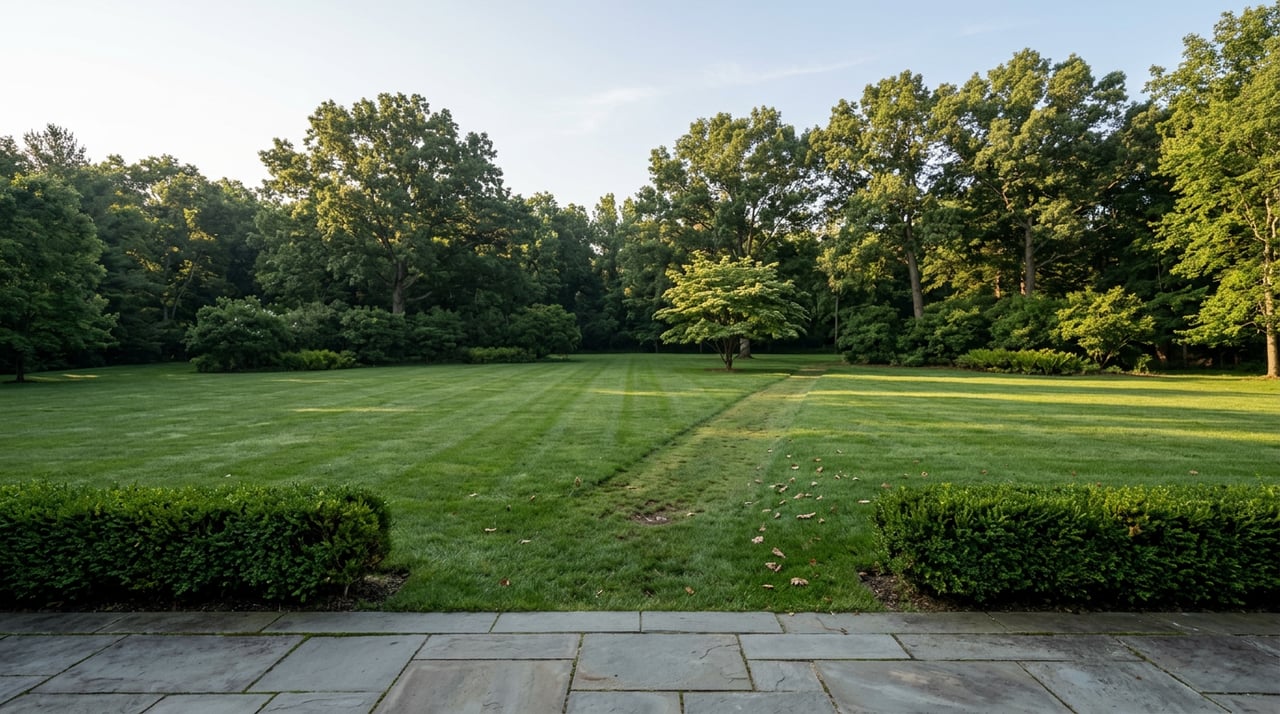
Muttontown Preserve has a mansion with a reflecting pond and manicured gardens, and a crumbling stone staircase in the woods that used to belong to an exiled European king. At 550 acres, it's really two different walks stitched into one property, and the entrance you choose decides which version of the place you get.
The preserve sits just over the Brookville line in Muttontown and East Norwich, and it's the largest nature preserve Nassau County owns. It didn't start as one property. It was assembled from several separate Gold Coast estates: the 100-acre Moore family estate that became the Chelsea Mansion grounds, roughly 400 acres bought from the Lansdell Christie estate that included the old Winthrop mansion, and a smaller 20-acre parcel donated by the Hammond family that once held a pre-Revolutionary farmhouse. That patchwork history is exactly why the preserve doesn't feel like a single, coherent park. It feels like different properties that happen to share a fence line, because that's precisely what it is.
The two entrances aren't interchangeable
If you've only ever parked in one lot, here's what you're missing on the other side.
| Muttontown Lane entrance | Route 106 / Equestrian Center entrance | |
|---|---|---|
| What's nearby | Chelsea Mansion, the nature center | King Zog's Knollwood ruins |
| Facilities | Restrooms and trail maps (hours limited) | None, no water, no map posted |
| Trail character | Mansion grounds, gardens, formal paths | Wilder, less maintained, more overgrown |
| Best for | A short walk with architectural payoff | A quicker route to the ruins |
Park at the Muttontown Lane entrance, near the nature center, and you'll walk grounds that still read as a designed landscape: clipped lawns near the Chelsea Mansion, a pond, formal plantings that someone clearly intended people to stroll past on purpose. Park instead at the Route 106 entrance by the old Equestrian Center, and you skip most of that. What you get there is closer to the woods finding their way back over 1920s stonework. Visitors who've used both entrances consistently describe the Route 106 side as having no posted maps and little trail maintenance, while the ruins themselves sit just a short walk in. If your goal is specifically to see the remains of the Knollwood mansion without a long hike, that's the faster door.
The two entrances lead to different sections of the preserve, so visitors who use one lot may miss features near the other.
Finding your way on the trails
Nassau County describes miles of marked nature trails. Hikers on trail apps and review sites have reported junctions without signage, trail names on maps that don't match physical signs on the ground, and loops that double back unexpectedly.
None of this means the preserve is hard to enjoy. It means it rewards a small amount of preparation. Grab a paper map at the nature center if it's staffed when you arrive, or pull up a trail app before you leave the car, because cell service in the wooded sections isn't something to count on. The confusion isn't a flaw so much as a feature of a property that was never designed as one continuous trail system in the first place. The preserve's paths were laid out to serve the separate estates, not a unified hiking loop.
Chelsea Mansion's public hours and private events
The Chelsea Mansion deserves its own explanation, because it lives a double life that trips up first-time visitors more than anything else on the property.
Benjamin and Alexandra Moore built the mansion in the mid-1920s after a trip up the Yangtze River in China, where they saw a farm manor with a stark white, black-trimmed facade reflected in the water and decided to recreate the feeling of it at home. They hired the architectural firm Delano & Aldrich, and the result blends French, English, and Chinese design touches into a 40-room house that's now on the National Register of Historic Places. Benjamin Moore also served as the first mayor of the Village of Muttontown, a detail that ties the mansion directly to the town's early governance rather than treating it as just another private estate.
Alexandra donated the surrounding acreage to Nassau County to start the preserve, and the county acquired the mansion itself after her death. The mansion now operates under Nassau County Parks, which brought on a caterer to manage its private event bookings back in 2021. That means the mansion functions as both a public historic site with seasonal open hours and an active rental venue for weddings and corporate events. On the days it's booked for a private function, the grounds around it close to the public for that event. If you've ever walked over expecting to see the gardens and found the gate blocked with no explanation, that's why. It isn't inconsistency. It's simply a working venue doing its job on any given Saturday.
What the ruins actually are
The Knollwood ruins get the most curiosity of anything on the property, and the real story is stranger than most people guess. The 60-room granite mansion was originally built for Wall Street investor Charles Hudson in the early 1900s. In 1951, King Zog of Albania, the country's last monarch, bought the 150-acre estate after fleeing Europe, reportedly hoping to use it as a base for a government in exile. He never moved in. He sold the property in 1955 to Lansdell Christie, and by then rumors had already spread that Zog had hidden treasure somewhere inside the walls. Those rumors brought vandals, the house fell into disrepair, and Christie had it demolished in 1959. What's left today, stone staircases, low walls, the outline of a walled garden, is genuinely all that survives of a mansion built for a Wall Street fortune and briefly owned by a deposed king who never spent a single night there.
Nassau Hall, on the same property, has a quieter but equally specific story. It was built for Bronson Winthrop and later renamed for Christie, who added a pinetum between 1956 and 1960 that's now one of the larger pine collections on Long Island. The building's exterior was modeled after Mount Vernon, which makes it an odd little architectural echo tucked into the same woods as a Gold Coast mansion and a king's abandoned ruin.
A short list for whichever door you use
- Facilities and staffed hours are limited and concentrated near the Muttontown Lane entrance, not the Route 106 side.
- Trail conditions get muddy near the low-lying wetland sections after rain, and tick exposure picks up through the warmer months.
- Cross-country skiing is possible on the trails in winter when snow cooperates.
- Dogs are generally welcome, but rules can vary by specific trail, so leash up and expect the occasional posted exception.
- Admission is free and the preserve keeps dawn-to-dusk hours, no permit required.
- If the mansion grounds are gated off on a weekend afternoon, it's almost certainly a private event, not a closure.
The preserve rewards people who treat it as two separate outings rather than one loop they've already checked off. Walk the mansion side on a quiet weekday morning when there's no event on the books, then come back another day and park at the Route 106 lot to find the ruins. Visiting both entrances on separate outings offers a fuller picture of the preserve.
If you're weighing a move to this part of the North Shore and want a clearer sense of what daily life looks like here beyond the market data, Dalia Elison is glad to talk it through. Schedule a Confidential Consultation whenever you're ready.
This article is general information, not legal, tax or financial advice. Consult a qualified professional about your situation.